Billboard Chris

Get the Facts · Systematic reviews

The gold standard in medicine. These systematic reviews looked at all of the scientific literature regarding sex-rejecting drugs and procedures for children.

Reviews in the U.S., Canada, England, Sweden, and Finland all came to the same conclusion.

The evidence in support of child transition is very weak or non-existent.

There is no justification for causing serious, lifelong physical harm in kids.

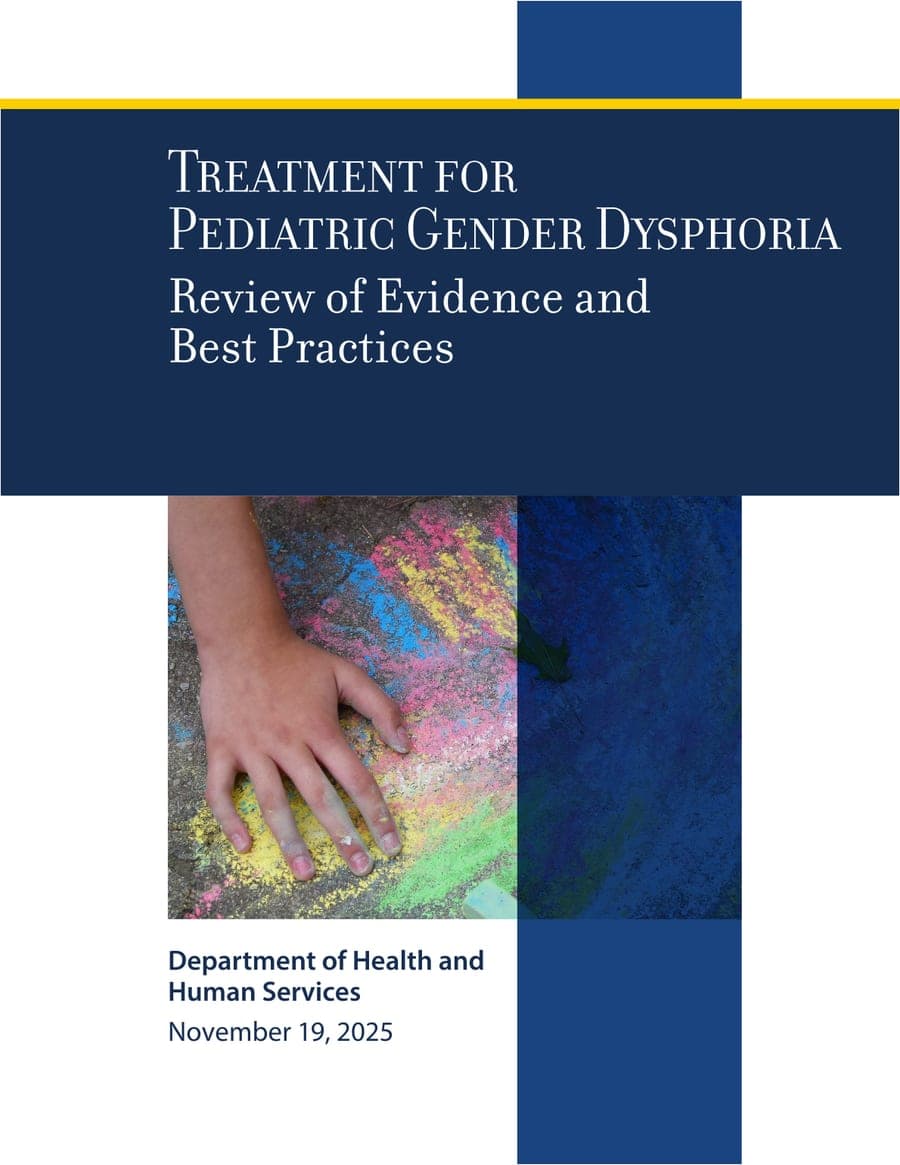
Cover of the HHS report Treatment for Pediatric Gender Dysphoria: Review of Evidence and Best Practices, 19 November 2025

2025 · United States

HHS Evidence Review: Treatment for Pediatric Gender Dysphoria (November 2025)

Study objective

Provide accurate information on the current evidence for treating gender dysphoria in children and adolescents, assess the state of medical practice in the U.S., and explore the ethical issues related to these treatments.

Findings

  • A lack of evidence demonstrating medical and surgical treatments for gender dysphoria in children improve mental health or reduce gender dysphoria effectively.
  • Puberty blockers and opposite-sex hormones can cause significant harms, such as infertility, making the risk/benefit balance unfavorable.
  • Weak evidence calls for cautious guidelines and policies, emphasizing ongoing evaluation and improved data collection.
  • Patients and families are not provided clear information on the benefits, risks, and uncertainties of treatments due to inadequate informed consent.
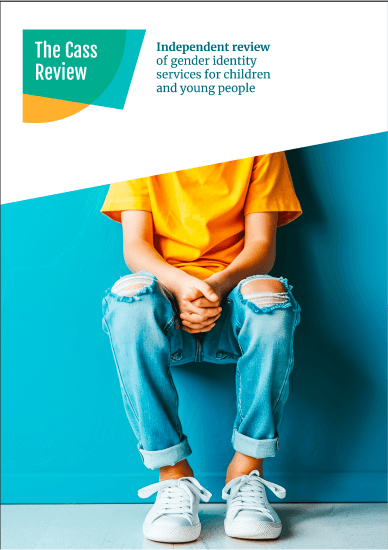
Cover of The Cass Review: Independent review of gender identity services for children and young people

2024 · United Kingdom

The Cass Review: Study of Adolescent Gender Dysphoria Treatment (UK)

Study objective

Independent Review of Gender Identity Services for Children and Young People to provide recommendations on issues related to the delivery of these services.

Findings

  • Early intervention studies (2015–2016) found no benefits from puberty blockers, with 2020 results confirming no positive outcomes.
  • Despite this, puberty blockers became routine in 2014, used on a wider patient group not meeting original research criteria.
  • Using a treatment with unclear benefits without further review significantly deviates from standard medical practice.
  • Cass is underpinned by the University of York systematic reviews in Archives of Disease in Childhood and by NICE’s earlier 2020 evidence reviews of puberty blockers (GnRH analogues) and opposite-sex hormones. Those papers are not listed as separate Facts cards.
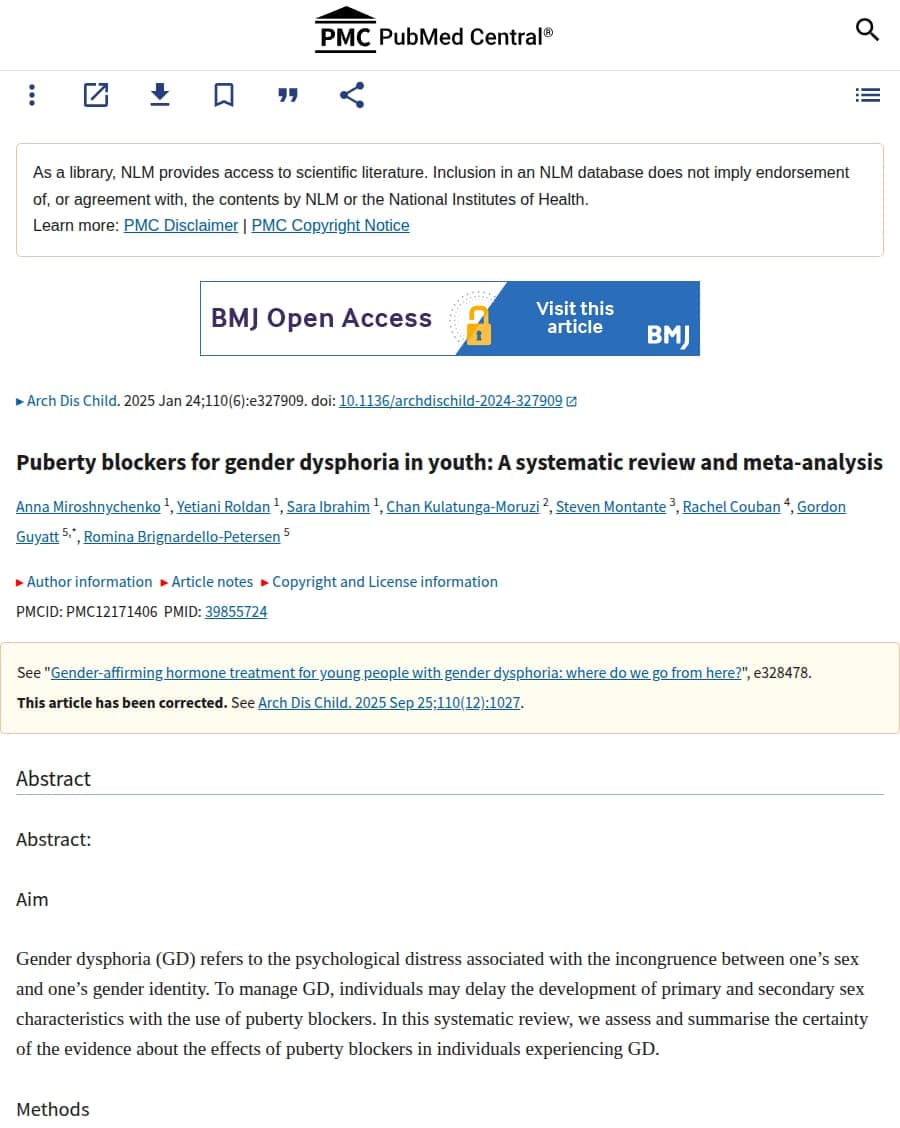
First page of Miroshnychenko et al., Archives of Disease in Childhood: Puberty blockers for gender dysphoria in youth

2025 · Canada

Canada — McMaster HEI systematic reviews: Puberty blockers, hormones, and mastectomy in youth — very low certainty evidence (2025)

Study objective

McMaster’s Department of Health Research Methods, Evidence, and Impact published GRADE systematic reviews of sex-rejecting procedures. The HEI department page does not list the papers one by one; the published reviews in that series are the puberty blockers and hormone reviews in Archives of Disease in Childhood and the mastectomy review in Plastic and Reconstructive Surgery.

Findings

  • Puberty blockers: 10 studies. Comparative observational evidence on global function and depression was very low certainty. Before–after evidence on gender dysphoria, global function, depression, and bone mineral density was very low certainty. The authors report considerable uncertainty about effects.
  • Opposite-sex hormones under 26: 24 studies. Comparative evidence was mostly very low certainty on dysphoria, global function, and depression. Before–after evidence was very low certainty. One comparative study reported lower odds of depression at low certainty (OR 0.73, 95% CI 0.61–0.88). The authors say they cannot exclude benefit or harm.
  • Mastectomy under 26: 39 studies. Comparative and before-and-after evidence ranged from low to very low certainty, including very low certainty on gender dysphoria, global functioning, and suicide attempts.
  • The HEI authors’ August 2025 statement says only low-certainty evidence exists, as graded by GRADE, on the benefits of the interventions they reviewed. That is an evidence finding.
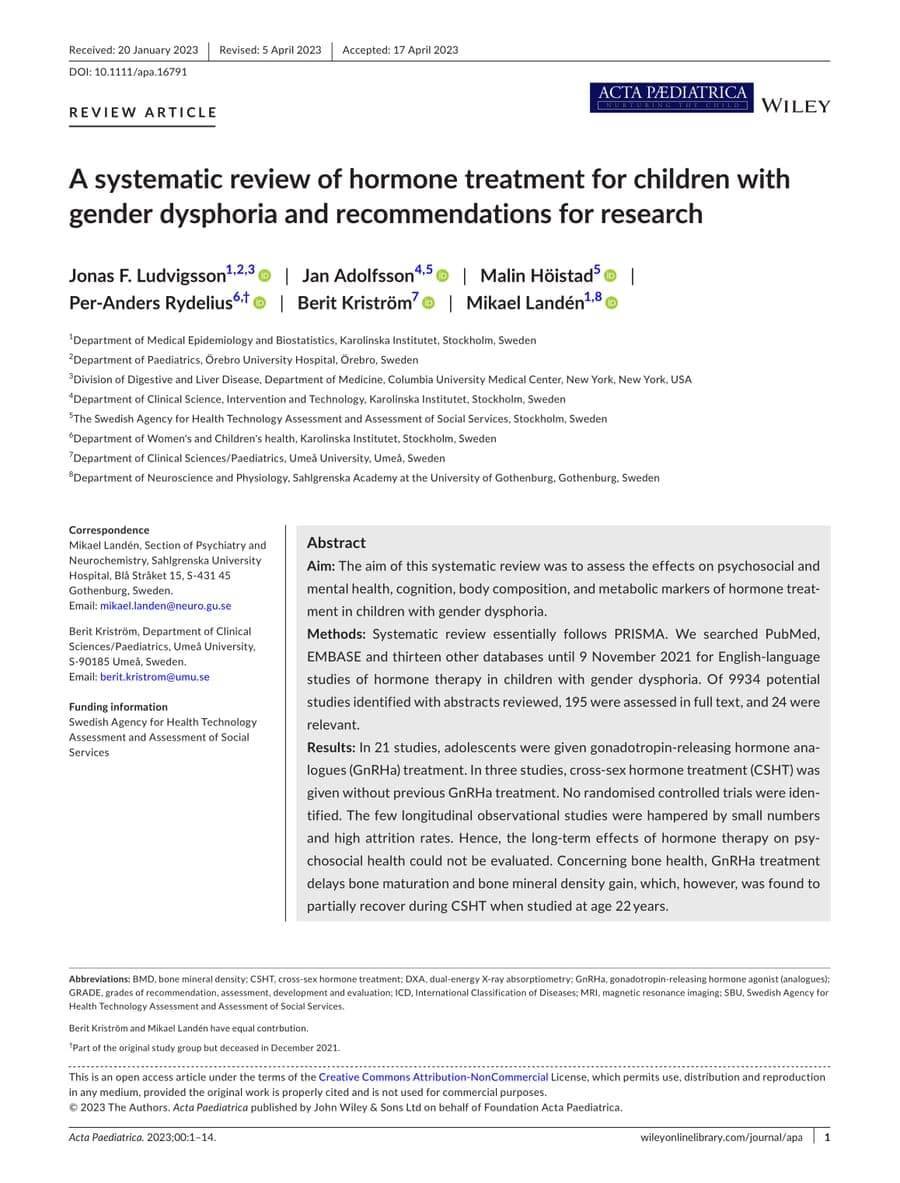
First page of Ludvigsson et al., Acta Paediatrica 2023, systematic review of hormone treatment for children with gender dysphoria

2023 · Sweden

Ludvigsson et al. 2023: Hormone treatment for children with gender dysphoria (Acta Paediatrica)

Study objective

Jonas F. Ludvigsson and colleagues published a PRISMA systematic review in Acta Paediatrica of hormone treatment in children with gender dysphoria — psychosocial and mental health, cognition, body composition, and metabolic markers. This is a peer-reviewed evidence synthesis.

Findings

  • Of 9,934 records, 24 studies were relevant: 21 of puberty blockers (GnRH analogues) in adolescents and 3 of opposite-sex hormones without prior puberty blockers (GnRH analogues). No randomised controlled trials were identified.
  • The few longitudinal observational studies were hampered by small numbers and high attrition. Long-term effects of hormone therapy on psychosocial health could not be evaluated.
  • Puberty blockers (GnRH analogues) delay bone maturation and bone-mineral-density gain. That density was found to partially recover during later opposite-sex hormone treatment when studied at age 22.
  • Evidence to assess those effects is insufficient. The authors present the GENDHOR checklist to improve future research. DOI 10.1111/apa.16791.
Cover of Socialstyrelsen’s English summary: Care of children and adolescents with gender dysphoria, December 2022

2022–2023 · Sweden

Sweden — Socialstyrelsen / SBU: Care of children and adolescents with gender dysphoria (December 2022)

Study objective

Sweden’s National Board of Health and Welfare (Socialstyrelsen) updated national guidelines after the Swedish Agency for Health Technology Assessment (SBU) systematic review found the evidence insufficient to assess puberty suppression and opposite-sex hormones in adolescents. This is that official evidence and guideline record — not the 2011 surgical follow-up study.

Findings

  • SBU’s systematic review concluded that existing scientific evidence is insufficient to assess the effects of puberty-suppressing and opposite-sex hormone therapy on gender dysphoria, psychosocial health, and quality of life in adolescents.
  • At group level, Socialstyrelsen assesses that the risks of puberty blockers and other sex-rejecting procedures are likely to outweigh the expected benefits.
  • It gives a weak negative recommendation: puberty blockers (GnRH analogues), opposite-sex hormones, and mastectomy may be administered in exceptional cases, preferably in research, using documented Dutch-protocol-style criteria.
  • This is a national restriction and research-setting recommendation.
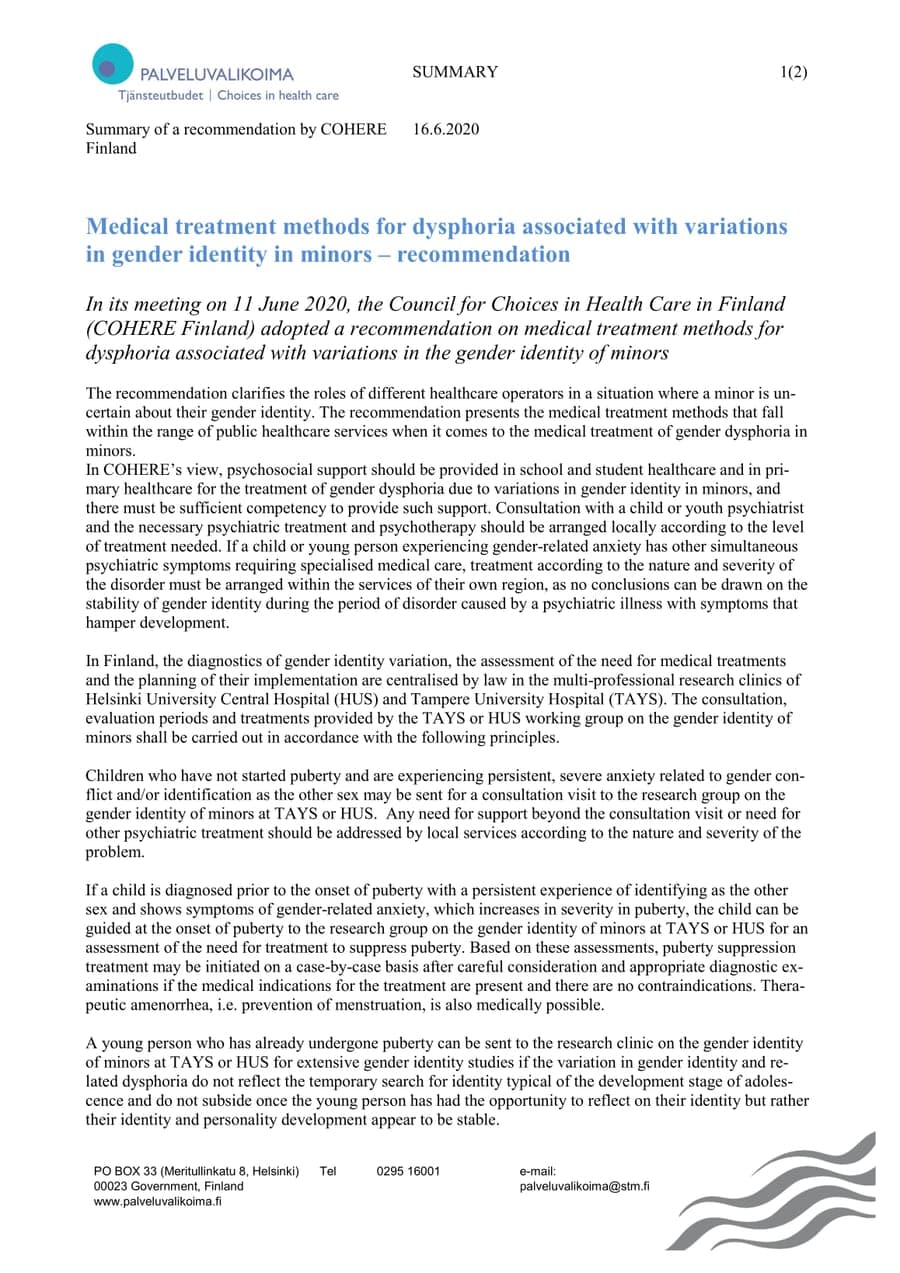
First page of COHERE Finland’s English summary on medical treatment methods for dysphoria in minors, 16 June 2020

2020 · Finland

Finland — COHERE: Medical treatment methods for dysphoria associated with variations in gender identity in minors (June 2020)

Study objective

The Council for Choices in Health Care in Finland (COHERE / PALKO) issued a recommendation on which medical treatments for gender dysphoria in minors belong in public healthcare. Research data on those treatments in minors, the recommendation states, is limited.

Findings

  • Psychosocial support should be provided in school, student, and primary healthcare. Psychiatric treatment for concurrent illness is arranged locally; no conclusions can be drawn on the stability of gender identity during an active psychiatric disorder.
  • Diagnostics, assessment of medical need, and planning are centralized at HUS and TAYS. Puberty suppression may be initiated only case-by-case after careful diagnostic examinations if indications are present and there are no contraindications.
  • Hormonal interventions that alter sex characteristics before 18 may be considered only if identity as the other sex is permanent and causes severe dysphoria, the young person can understand irreversible lifelong hormone therapy, and no contraindications are present.
  • Surgical treatments are not part of the treatment methods for dysphoria caused by gender-related conflicts in minors. This is a health-service recommendation.

Subscribe. Get Updates.

News, legal victories, and tools to speak the truth — one conversation at a time.

Send your email and we’ll add you. The fastest way to follow the street conversations is still @billboardchris on X, YouTube, Facebook, and Instagram.