Billboard Chris

Get the Facts · Suicide Myth

Suicide facts

The threat of suicide is the number one tactic that activist doctors, politicians, and medical bodies have used for years to buy support for child transition.

Parents are even told they can have a dead daughter or a live son. This is coercive manipulation and a despicable lie.

The facts are in. Completed suicide is thankfully rare, and pediatric medical transition has not been shown to prevent suicide.

The studies

Read the chart, not a wall of links. Youth studies are not adult studies. A survey of suicide attempts is not a count of suicide deaths.

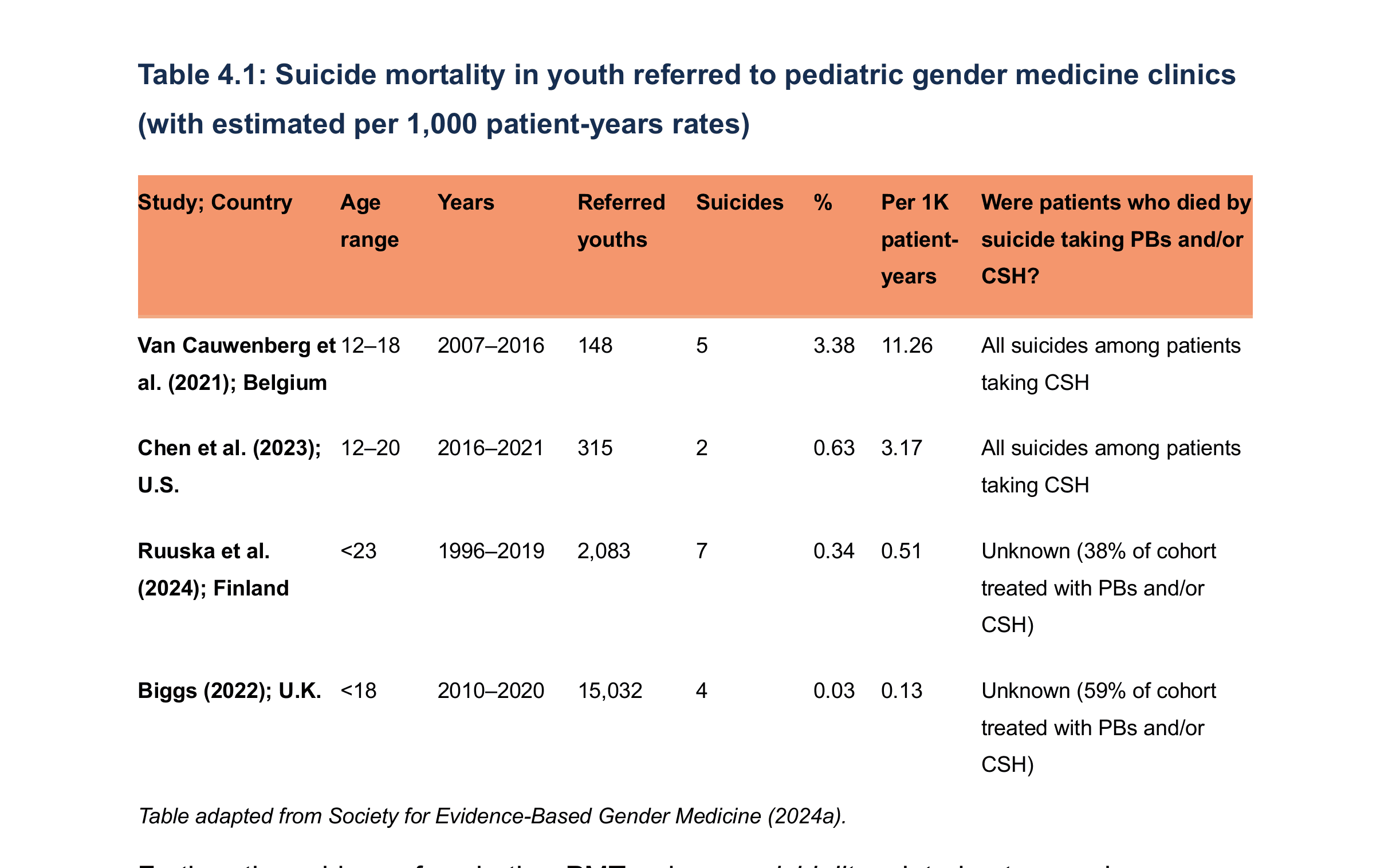
HHS Table 4.1: Suicide mortality in youth referred to pediatric gender medicine clinics, with estimated per 1,000 patient-years rates.
Table 4.1, HHS Treatment for Pediatric Gender Dysphoria (2025). HHS report (PDF) →

News — Supreme Court exchange

ACLU Attorney Confesses: Transgender-Suicide Claim is a Myth (City Journal)

In U.S. v. Skrmetti oral argument (Dec 4, 2024), ACLU attorney Chase Strangio told Justice Alito there is no evidence in the studies that gender-affirming treatment reduces completed suicide, and that completed suicide is “thankfully and admittedly” rare — while distinguishing that from “suicidality.”

City Journal →

Suicide-related findings from Biggs (2022), Van Cauwenberg (2021), Ruuska (2024), Do No Harm, Cass, HHS, and Dhejne 2011

Study

Biggs (2022) — Suicide by Clinic-Referred Transgender Adolescents in the United Kingdom. Arch Sex Behav.

Tavistock GIDS referrals, 2010–2020.

Finding

Among ~15,032 youth referred to Tavistock GIDS (2010–2020), 4 suicides — completed suicide rare in absolute terms (HHS Table 4.1: 0.03%, 0.13 per 1K patient-years).

Study

Van Cauwenberg et al. (2021) — Ten years of experience in counseling gender diverse youth in Flanders, Belgium

Belgian pediatric gender clinic cohort.

Finding

Belgian pediatric gender clinic cohort; 5 suicides among referred youths (HHS Table 4.1: 3.38%, 11.26 per 1K patient-years); HHS notes all suicides among patients taking cross-sex hormones.

Study

Finland — Ruuska et al. (2024)

Youth and young adults under 23 referred to Finnish gender services, 1996–2019: 2,083 people vs 16,643 matched controls.

Finding

Suicide deaths were uncommon (0.3% vs 0.1% in matched peers) and, once specialist psychiatric treatment was accounted for, not statistically different; medical gender reassignment was not shown to change suicide risk.

Study

Do No Harm — Greene & Kingsbury (17 September 2026)

New — 17 September 2026

CDC teen suicide rates after state bans on puberty blockers, opposite-sex hormones, and surgeries for minors. Jay Greene, Ph.D. and Ian Kingsbury, Ph.D. for Do No Harm. Three models: difference-in-differences, Callaway–Sant’Anna DiD, and a national time-series.

Finding

Do No Harm analyzed CDC teen suicide rates after state bans on puberty blockers, opposite-sex hormones, and surgeries for minors. Across three models (difference-in-differences, Callaway–Sant’Anna DiD, and a national time-series), there was no statistically significant increase in teen suicide rates. The claim that these bans cause a spike in teen suicides is not supported by the data.

Study

Cass Review (2024)

Independent review of NHS gender identity services for children and young people, underpinned by University of York systematic reviews.

Finding

The evidence does not support the claim that hormone treatment reduces the elevated risk of death by suicide in this population.

Study

HHS evidence review (November 2025)

U.S. Department of Health and Human Services review of treatment for pediatric gender dysphoria. The suicide points on this chart are from that review.

Finding

There is no evidence that pediatric medical transition reduces suicide deaths, which remain very low; completed suicide among adolescents with gender dysphoria is rare, and suicidality tracks with other mental-health conditions rather than with gender dysphoria alone.

Study

Dhejne et al. (2011) — Long-Term Follow-Up of Transsexual Persons Undergoing Sex Reassignment Surgery: Cohort Study in Sweden. PLOS ONE.

Adults. All 324 people in Sweden who had sex-reassignment surgery, 1973–2003, compared with matched population controls.

Finding

After sex reassignment / surgical transition, suicide deaths were about 19.1 times higher than among matched peers (adjusted hazard ratio 19.1). Transition did not bring suicide mortality in line with the general population — the elevated suicide risk remained after transition.

The old GIDS “Evidence base” webpage is gone, so it is not a source here. The official UK follow-up is the 2024 Appleby report on Tavistock / GIDS suicides: the data do not support a large rise after puberty blockers were restricted. Appleby 2024 — Tavistock / GIDS suicides (GOV.UK) →

Subscribe. Get Updates.

News, legal victories, and tools to speak the truth — one conversation at a time.

Send your email and we’ll add you. The fastest way to follow the street conversations is still @billboardchris on X, YouTube, Facebook, and Instagram.