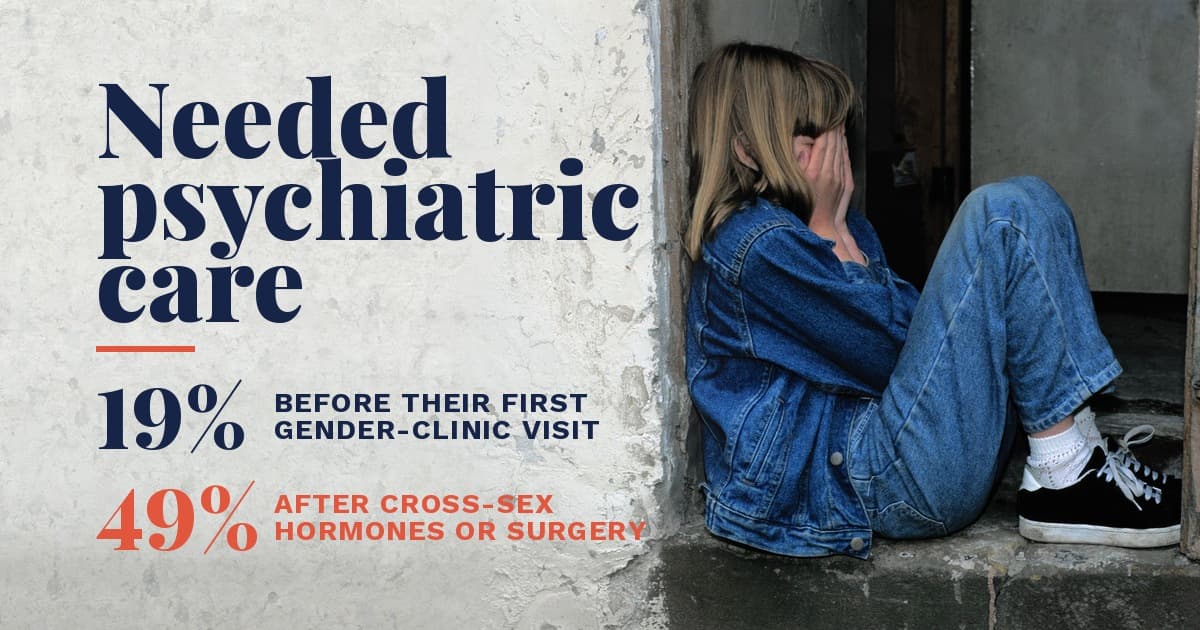
We were told cross-sex hormones and surgery would fix these young people's mental health. Finland checked. After the drugs and the surgery, far more of them needed psychiatric care, not fewer.
What Finland found
Finland sends every young person who wants a medical "gender reassignment" to one of two university hospital clinics, in Helsinki and Tampere. Researchers led by Dr. Sami-Matti Ruuska, an adolescent psychiatrist, and Prof. Riittakerttu Kaltiala, a professor of adolescent psychiatry at Tampere University, pulled the national health records for every one of them.
That's 2,083 people under 23 who went to those clinics between 1996 and 2019. Each was matched with eight people of the same birth year and hometown, 16,643 in all. Some were followed for up to 25 years. Their paper ran in Acta Paediatrica in April (Ruuska et al., 2026).
In Finland, specialist psychiatric care is only for serious mental illness. Mild and moderate problems are handled by family doctors. A patient leaves specialist care once they're well.
The new numbers
Critics claimed the first analysis might have counted people who hadn't had their drugs or surgery yet. So in September the authors ran it again, starting the clock only after each person's last step: cross-sex hormones, breast removal, or genital surgery (Ruuska et al., Sept. 2026).
- Before their first gender-clinic visit, 19.2% had needed specialist psychiatric care.
- At some point after their last procedure, 48.9% did.
- Their matched peers, counted from the same dates, went from 14.4% to 13.2%.
After their last procedure, these young people were about six times as likely as the general population to need specialist psychiatric care. That held for both males and females who had the drugs or surgery.
They started out healthier
Finland screens out young people with serious, unstable mental illness before it gives cross-sex hormones. So the ones who got them started out in much better shape than the other young people at the clinic.
The original April paper shows what happened next (Ruuska et al., 2026). It counted anyone who needed specialist psychiatric care at any point from two years after their first clinic visit to the end of the study:
- Males given cross-sex hormones or surgery: 9.8% had needed specialist psychiatric care before the clinic. From two years after their first visit on, 60.7% did.
- Females given cross-sex hormones or surgery: 21.6% before. 54.5% after.
Put the sexes together and it's 19.2% before, the same starting point as the September numbers, and about 56% after.
Why is September's 48.9% lower? It's the same young people, counted a different way. The April count starts two years after the first clinic visit. The September count starts only after the last procedure, which can be years later, so it covers less time. Count it either way and the share needing psychiatric care more than doubled. Their peers stayed flat.
The healthiest went in. They came out about as sick as everyone else at the clinic.
"Psychiatric needs do not subside after medical gender reassignment," the authors concluded. They added that "in some individuals, medical GR appears to be linked to deterioration in mental health."
Nearly 50 critics. The authors didn't budge.
Nearly 50 researchers and clinicians signed a letter of concern to the journal, and other critics sent letters too. PsyPost reports the letter asked the journal to reconsider the paper.
The authors answered twice in print. In May they re-ran the numbers starting five or more years after the first clinic visit and found the same raised risk (Ruuska et al., May 2026). In September they did the after-the-last-procedure analysis above.
"Some of the critique seems to be driven by an attempt to discredit scientific findings that do not align with the critics' preferred agenda, typical in gender medicine," they wrote in May. "The scientific and ethical responsibility invoked is fulfilled not by withholding inconvenient evidence, but by ensuring that the scientific community has access to accumulating information."
The bottom line
The promise was that cross-sex hormones and surgery would ease these young people's suffering. Finland followed every one of them for up to 25 years. After their last procedure, half of them needed specialist psychiatric care.
More on this study: Facts: Finland register study and our April story.
Sources
- Ruuska S-M, Tuisku K, Holttinen T, Kaltiala R. "Psychiatric Morbidity Among Adolescents and Young Adults Who Contacted Specialised Gender Identity Services in Finland in 1996–2019: A Register Study." Acta Paediatrica 115(7):1545–1553, 2026. doi:10.1111/apa.70533
- Ruuska S-M, Tuisku K, Holttinen T, Kaltiala R. "Response to the Critique by Edmiston et al., Banos et al. and Sandri et al. of Ruuska et al." Acta Paediatrica 115(9):2044–2045, 2026. doi:10.1111/apa.70618
- Ruuska S-M, Tuisku K, Holttinen T, Kaltiala R. "Response to the Critique by Banos et al. of Ruuska et al." Acta Paediatrica, Sept. 15, 2026. doi:10.1111/apa.70767
- Eric W. Dolan, PsyPost, Oct. 18, 2026
Cover photo: Pixabay via Pexels